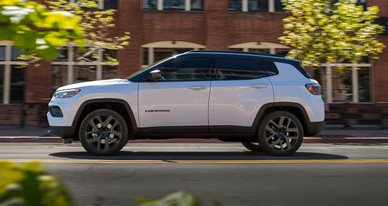
Choosing a small SUV for daily driving in northern New Jersey means thinking about more than just looks. Between the 2026 Jeep Compass and the 2026 Mazda CX-5, both vehicles have genuine strengths, but they're built with different drivers in mind. If your commute runs through Fort Lee, Ridgefield Park, or Cliffside Park, you already know what you're dealing with: stop-and-go traffic and tight parking structures, plus February weather that shows up without any warning.
The Compass brings standard Jeep Active Drive 4x4 across all trims, 200 hp, and 221 lb-ft of torque available as low as 1,750 rpm, the kind of setup that earns its keep in winter. The CX-5 responds with a more refined interior, smoother ride quality, and strong resale value. At Chrysler Dodge Jeep Ram of Englewood Cliffs, we work with Bergen County drivers every day, and we see both profiles clearly. If you want to get a feel for what the Compass offers before reading further, you can explore our 2026 Jeep Compass inventory now. This comparison will help you understand which vehicle actually fits the way you drive.
Performance and Power: Torque, AWD, and City Confidence
Both SUVs deliver capable everyday performance, but the way they deliver it differs noticeably once you're behind the wheel in real driving conditions.
| Specification | 2026 Jeep Compass | 2026 Mazda CX-5 |
|---|---|---|
| Horsepower | 200 hp | 187 hp |
| Torque | 221 lb-ft @ 1,750 rpm | 186 lb-ft |
| MPG (City / Highway / Combined) | 23 / 31 / 26 | 24 / 30 / 26 |
| Fuel Tank | 13.5 gallons | 14.8 gallons |
| Towing Capacity | 2,000 lbs | 2,000 lbs |
| Drivetrain | Standard Jeep Active Drive 4x4 (all trims) | Standard i-Activ AWD with G-Vectoring Control Plus |
| Engine | 2.0L turbocharged inline-4 | 2.5L Skyactiv-G inline-4 (naturally aspirated) |
Engine Specs and What They Mean Behind the Wheel
The 2026 Jeep Compass runs a 2.0L turbocharged inline-4 producing 200 hp and 221 lb-ft of torque, with that torque arriving at just 1,750 rpm. In practice, the Compass pulls hard the moment you ask it to. Merging onto Route 4 in traffic or accelerating out of a tight intersection on a cold morning, you're not waiting for the engine to build into its powerband. It responds immediately.
The 2026 Mazda CX-5 runs a 2.5L Skyactiv-G inline-4 rated at 187 hp and 186 lb-ft of torque. On paper, it trails the Compass. On pavement, though, it delivers power in a smooth, linear way that feels polished and confident. The CX-5 is genuinely enjoyable to drive, and for anyone whose route stays on well-maintained roads, the power difference is rarely something you notice. For drivers who regularly push through heavier loads, tow small trailers, or simply want more urgency on highway on-ramps, the Compass advantage is real.
AWD Capability and Winter Driving in Northern NJ
Winter driving in Bergen County is not something you plan around, it just arrives. Black ice and slushy intersections are part of life from November through March. Jeep Active Drive 4x4, standard on every 2026 Compass trim, is designed for that kind of environment. It actively manages traction across varying surfaces rather than reacting after grip is already lost, and it suits conditions that go well beyond a slick on-ramp.
Mazda's i-Activ AWD is a capable system backed by G-Vectoring Control Plus, which fine-tunes torque distribution through corners for smooth, predictable handling. It's well-suited for wet highways and light snow. Drivers who stay on paved roads will find it more than adequate. For those who occasionally face deeper snow, uncleared side streets, or unpaved surfaces, the Compass's system offers meaningfully more confidence. In northern NJ, that difference shows up more often than you might expect.
Fuel Economy and Daily Efficiency on NJ Roads
Fuel efficiency matters when you're logging consistent miles through Bergen County and beyond. EPA figures for the 2026 Jeep Compass come in at 23 mpg city, 31 mpg highway, and 26 mpg combined, with a 13.5-gallon tank. The 2026 Mazda CX-5 rates at 24 mpg city, 30 mpg highway, and 26 mpg combined, with a 14.8-gallon tank.
The combined rating is identical, so neither vehicle holds a clear overall edge for efficiency. The Compass is the stronger performer on the highway, which matters for anyone covering stretches of Route 95 regularly. The CX-5's larger tank means fewer fill-up stops during mixed urban and suburban routines, which is a legitimate convenience advantage. If combined efficiency is your benchmark, these two vehicles are even. The decision comes down to where you drive most.
Interior, Comfort, and Cargo for Everyday Use
The daily experience inside a small SUV matters as much as what happens under the hood, especially when you're spending real time in stop-and-go traffic.
Cabin Materials, Refinement, and Ride Quality
The Mazda CX-5 has earned a strong reputation for its premium cabin. Optional nappa leather, ventilated seats, and noticeably better sound insulation put it a segment above its price point. If interior refinement is where you focus when you sit inside a vehicle, the CX-5 is genuinely hard to argue against.
The Compass offers a well-built, practical interior that holds up well under real-world use. For families hauling wet gear or muddy boots through the seasons, the Compass's durable materials are an advantage rather than a compromise. Its fold-flat front passenger seat adds flexibility the CX-5 doesn't offer, which is useful for carrying long items without renting a truck. Ride quality in both SUVs is comfortable for city and highway use, though the CX-5 leans sportier while the Compass feels more settled across varied road surfaces.
Passenger Space, Cargo Room, and Urban Practicality
Cargo capacity is an area where the CX-5 holds a clear advantage, and we won't minimize it. With seats up, the CX-5 offers 33.7 cu ft versus 27.2 cu ft in the Compass. With seats folded, that gap continues: 66.5 cu ft versus 59.8 cu ft. If you're regularly hauling gear, groceries, or equipment, the CX-5's numbers are meaningfully better.
Both vehicles share a 2,000-lb towing capacity, which covers the occasional small trailer or utility haul for either buyer. The Compass's fold-flat passenger seat partially offsets its smaller cargo volume for drivers who need to carry long, awkward items, but the overall cargo gap is real and worth knowing.
Technology and Safety Features
Both vehicles come well-equipped with connectivity and driver-assistance technology, but the differences in safety system design are worth understanding clearly.
The CX-5 holds a genuine edge in automated safety features. Its standard equipment includes Rear Automatic Emergency Braking, Rear Cross Traffic Braking, intersection assist, and a 360-degree HD monitor. These are systems that intervene, not just warn, which is a meaningful distinction in dense Bergen County parking lots and busy intersections. The Compass offers available Rear Cross Path Detection, providing a warning without automatic braking. If fully automated rear-end intervention is a priority for you, the CX-5 is the stronger choice here, and we think that's worth saying directly.
Where the Compass balances things out is in its broader range of individually configurable safety options and adaptive cruise control as standard on Limited, Trailhawk, and Limited Altitude trims. Smartphone integration including Apple CarPlay and Android Auto comes standard on both vehicles, covering the connectivity baseline most drivers expect.
Urban Driving Practicality: Parking, Maneuverability, and NJ Commuting
Urban driving practicality goes beyond highway performance. How a vehicle handles narrow streets, crowded parking lots, and dense commuter traffic matters just as much day to day.
Turning Radius, Visibility, and Tight-Space Confidence
The CX-5 runs approximately 11 inches longer than the Compass, a difference that shows up in real Englewood Cliffs parking garages and tight residential streets. That extra length requires a bit more planning when parallel parking or turning in confined spaces. The Compass's more compact footprint is a genuine practical advantage in urban environments where space is limited.
The CX-5's 360-degree HD camera is a confidence-builder when squeezing into tight spots or backing into narrow driveways. The Compass's upright stance and good forward sightlines give drivers a strong sense of the vehicle's position without relying as heavily on camera systems. Both approaches work, but for drivers who lean on technology for parking confidence, the CX-5's camera setup is a real asset.
Best For: City Commuting vs. All-Weather Capability
Mazda CX-5: Best for City Commuting
-
Interior refinement and premium materials
-
Standard Rear Automatic Emergency Braking and Rear Cross Traffic Braking
-
Rain-sensing wipers and remote window control
-
360-degree HD monitor for parking confidence
-
Larger cargo volume (33.7 cu ft seats up)
-
Smooth, composed city ride quality
Jeep Compass: Best for All-Weather Capability
-
Standard Jeep Active Drive 4x4 across all trims
-
221 lb-ft of torque at 1,750 rpm for immediate response in any condition
-
Fold-flat passenger seat for versatile cargo configurations
-
Durable cabin materials suited to seasonal wear
-
More compact footprint for tight urban maneuvering
-
Adaptive cruise control standard on select trims
Verdict: Which Small SUV Should Englewood Cliffs Drivers Choose?
The 2026 Mazda CX-5 makes the most sense for drivers who put interior refinement at the top of their list and spend the bulk of their time on paved roads in predictable conditions. Its standard rear automatic emergency braking and 360-degree parking camera give it a real edge for drivers who want fully automated intervention rather than warnings alone, and its larger cargo volume rewards anyone who regularly hauls bigger loads. If a smooth, sporty driving feel on daily commuter routes is what you're after, the CX-5 delivers that consistently.
The 2026 Jeep Compass is the better fit for drivers who need standard 4WD capability for Bergen County winters without paying extra to get it. Its stronger torque makes highway merging and more demanding driving situations feel effortless, and the fold-flat passenger seat gives you flexibility the CX-5 simply doesn't offer when cargo shapes get awkward. A more compact footprint also makes a real difference in tight urban parking and maneuvering, and adaptive cruise control comes standard on select trims alongside a broader range of configurable safety options.
For Bergen County drivers who need one SUV to handle winter storms, unpredictable road conditions, and the full range of what northern NJ delivers year-round, the 2026 Jeep Compass is the more complete answer.
Explore the 2026 Jeep Compass at Chrysler Dodge Jeep Ram of Englewood Cliffs
Chrysler Dodge Jeep Ram of Englewood Cliffs is located at 100 Sylvan Ave, just off Route 4, serving drivers across northern NJ and the nearby NY market. We carry new 2026 Jeep Compass models and a full certified pre-owned inventory, and our team is ready to help you match the right vehicle to the way you actually drive.
You can browse available models online before visiting or schedule a test drive directly. Driving the Compass on real local roads is the most practical way to confirm it fits your commute. When you're ready to move forward, contact our team with any questions about inventory or trade-in options.
Photo Courtesy of Jeep